
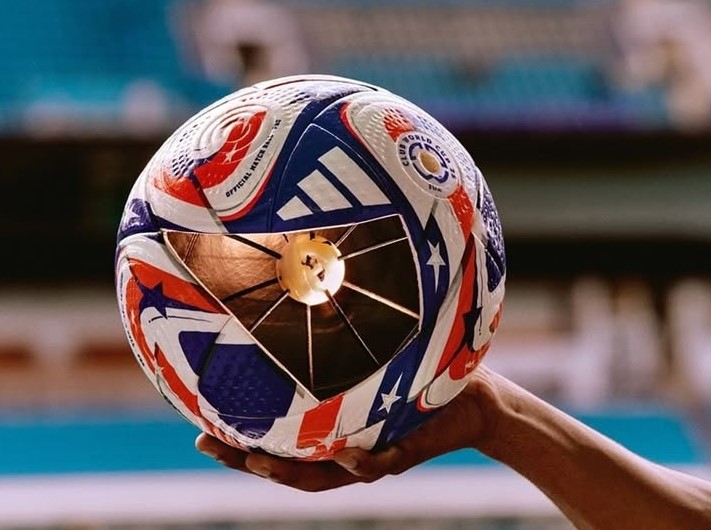
At first glance, the Adidas Trionda looks like any other high-end football. With its striking red, green, and blue design paying homage to the three host nations, it is undeniably eye-catching. But beneath its vibrant surface lies a technological marvel that is fundamentally changing how the beautiful game is played, officiated, and experienced. The official match ball of the 2026 FIFA World Cup is no longer just a piece of equipment; it is a sophisticated data-gathering device, a digital witness to every pass, shot, and touch.
Inside the “Trionda”: A 500Hz Brain
At the heart of the Trionda is a miniature inertial measurement unit (IMU) motion-sensor chip, capable of recording and transmitting data at up to 500 times per second. This “connected ball” technology captures a comprehensive range of metrics, including the ball’s position, acceleration, speed, rotation, and even the exact moment and force of a player’s touch. This represents a significant evolution from the previous generation of smart balls used in the 2022 World Cup.
The technological leap is not just in the sensor but in its placement. In previous iterations, the IMU sensor was suspended in the center of the ball, a design that, while balanced, could be vulnerable to the extreme, asymmetric forces of high-level play. For the Trionda, Adidas and its partners have innovated a side-mounted system. The sensor is now embedded within one of the ball’s four thermally bonded panels, while the other three panels contain counterbalancing weights to maintain perfect flight stability and weight distribution.
This evolution extends to the ball’s very structure. The Trionda features only four panels, the fewest ever used for a World Cup ball, replacing the 20-panel design of 2022. While fewer panels might suggest a more erratic flight, engineers incorporated deep grooves and an enhanced surface texture to ensure a predictable and consistent trajectory. Wind tunnel tests confirm this, showing a stable coefficient of drag that gives players the control they expect at the highest level.
Data in Action: Revolutionizing Officiating
The primary purpose of this embedded technology is to support match officials. The data from the ball’s IMU sensor is transmitted in real time to the Video Assistant Referee (VAR) system. Here, it is combined with player-tracking data from 16 dedicated optical cameras installed in each stadium, which capture 29 data points on each player 50 times a second. This convergence of data from the ball and the players creates a “digital replica” of the match, allowing for unprecedented levels of accuracy and speed in decision-making.
For offside decisions, the Trionda’s technology is indispensable. The semi-automated offside system requires absolute certainty on the exact moment a player touches the ball—the “kick point.” The 500Hz sensor within the Trionda provides this information with millisecond precision, far surpassing what can be gleaned from broadcast footage alone. This data allows the VAR to make quicker and more accurate offside calls, especially in those agonizingly tight situations where millimeters separate a goal from a free kick.
Beyond offside, the ball’s data is also being used to help referees with other complex decisions. The system can assist in determining whether a handball occurred by detecting contact with the ball that might be difficult to see on video. It can also be used to definitively judge if the ball went out of play before a goal was scored. As the International Football Association Board (IFAB) emphasizes, “It helps referees make better decisions and is more transparent for fans.”
A “Digital Replica” for Coaches and Broadcasters
The impact of this technology extends far beyond the referee’s booth. The torrent of data generated by the Trionda is a goldmine for coaches, analysts, and broadcasters.
For coaches, the ball’s data provides quantifiable insights into performance. They can now measure the exact speed of a shot, the spin of a cross, and the trajectory of a pass, offering a new layer of objective analysis to inform tactics and training.
For fans, this technology enhances the viewing experience. The data enables broadcasters to create 3D animations and detailed graphics that illustrate key moments of the game. The precise kick-point identified by the ball is used to visually explain offside decisions, providing a level of transparency and understanding that was previously impossible. The goal is to bring the audience closer to the game by demystifying complex officiating calls.
The “Made in China” Story
The manufacturing story of the Trionda is as fascinating as its technology. While Adidas is the official designer and brand, the ball’s production is a testament to global collaboration and Chinese manufacturing expertise.
The intelligent ball core, housing the critical IMU sensor chip, is produced by a company in Huai’an, China. This component is so precise that the entire ball’s weight deviation must be kept within an incredible 0.5 grams to ensure consistent flight performance. The final assembly and production of the official match balls, however, takes place in a specialized Adidas factory in the Guangming District of Shenzhen, Guangdong, China. This factory, which has been making World Cup balls since 2010, has a proven track record of delivering the highest quality for the world’s biggest stage.
Conclusion: A New Era for the Game
The Adidas Trionda is far more than a ball; it is a testament to how innovation is reshaping football. Its 500Hz IMU sensor, side-mounted design, and integration with a network of cameras are creating a digital ecosystem that enhances officiating accuracy, enriches tactical analysis, and improves the fan experience. While the technology is a powerful tool, it is important to remember that it serves the game and its officials, not the other way around. As FIFA states, the final decision always rests with the referee. The Trionda is there to ensure they have the most complete and accurate information possible to make that decision, heralding a new era of precision and transparency in the world’s most beloved sport.